



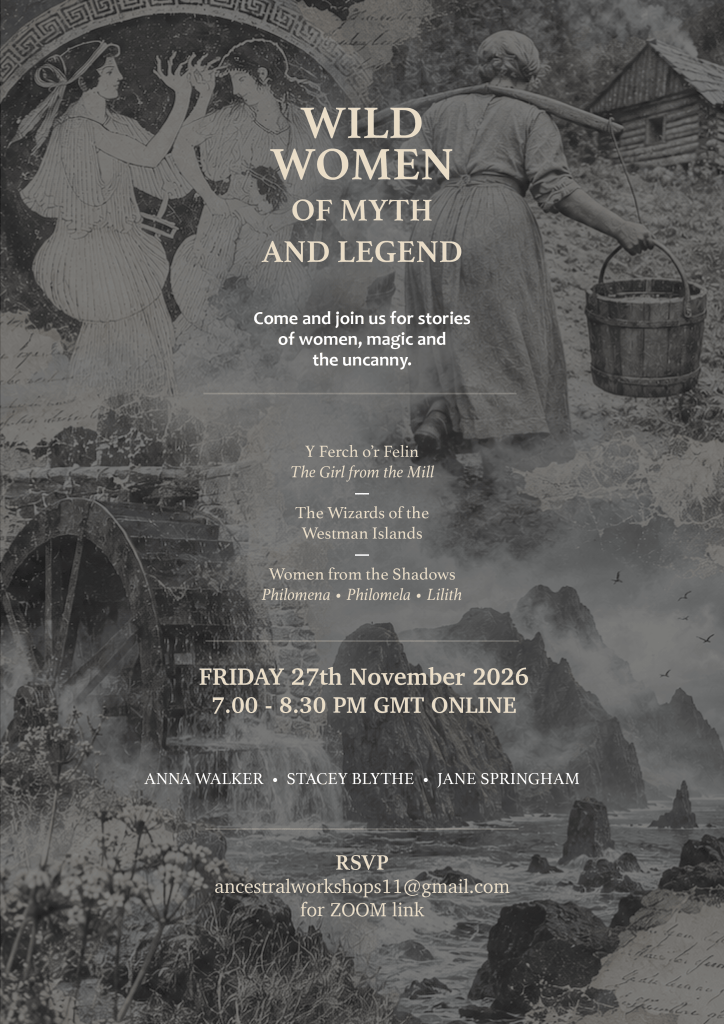
I’ve been researching stories of wild women, forgotten and lost women for an online storytelling event. I’m not a natural performer, but I love telling stories, and every time I say yes, I am crippled with anxiety wondering what the hell I was thinking.
St Philomena, Philomela, Lilith – these are the tales I’m pondering, their connective tissue, the words that link story to story. When in doubt I walk. Walk the stories, feel them move through my body. Pause. Tell the trees, the fields, bushes and hedgerows. Storytelling becomes mumbling when a dog walker passes by or I switch the tone of my voice as if I’m talking to someone on my phone. But when no one is watching I perform for the clouds, with arms gesticulating and voice loud and clear.
In a meeting this morning of fellow artists and walkers, we were discussing the performative aspects of walking. Questions emerged about those times when we are not performing, for ourselves, for others? In sleep surely. But in remembering my dreams my imagination performs for me, urging connections, lucid moments, interruptions to remember the flashing stories of night wanderings. Even now writing I am aware that there is a measure of performance, as I read, type, reflect, listen to my thoughts.
I was raised Irish Catholic and confirmed when I was 11. Confirmation comes from the Latin confirmare, “to strengthen.” Through a ritual of naming, we become soldiers of Christ – called to fight the spiritual war between good and evil, light and darkness. I practice no longer, haven’t for years, but I’ve been remembering. As was the custom, my mother passed down her saint’s name, from the oldest daughter to the oldest daughter. A saint, a special heavenly guide, protector, and intercessor. Studying that Saint’s life was to teach Christian virtues, and faithfulness. A life to imitate. My saint: St Philomena, came to mean “Daughter of light” Lumena pax tecum fi, the Greek derivation is usually given as philoumene, “beloved” or “being loved”,
Needless to say, at that time for an 11-year-old who was questioning the existence of God, this was challenging. I pushed back the only way I knew how, through my clothes. I had no plans to dress in white and kneel at any altar. So, I went shopping. Remember crimplene? Well, my dress was made of crimplene. It had long white puffy sleeves and a large white collar. The front and back were a perfect swirl of dark blue and green paisley, and most important of all, it was short, mid-thigh short. And perched on top of my ringlets—prepared the night before with rags—a blue woollen cap with a peak. Blue for the Virgin Mary. I seem to remember the priest was faintly amused, but Sister Christopher had a scowl on her face that would have made the angels weep and the devil smile from ear to ear.
St Philomena is an interesting saint. Her bones were found in the catacombs of Priscilla in Rome, in 1802 during excavations. Her relics were later brought to a village in Avellino, and it was here, in a revelation that Sr Maria Luisa first heard her story. A story whispered to her across space and time.
When Philomena was confirmed, she decided to become a bride of Christ, but that was not the plan her parents had for her.
The Roman Emperor Diocletian waged war on the small Grecian state where she was born. To keep the peace her father betrothed her to the emperor. She refused, and her constant refusals despite imprisonment, torture and humiliation eventually ended in her death by beheading, after being denounced as a witch. I think of Philomena as I walk, her petite 13-year-old body, not yet bleeding and the courage it must have taken to stand up to her parents, to the emperor many years her senior. I’d like to think that this is the reason why her name was passed down from generation to generation, for her courage and determination.
Before Philomena there was Philomela, (lover of song). I’m still sitting with the connective tissue between them both, seeking out the links other than their names, and that both of their stories originated in Greece. One is based on truth— perhaps, for we can never quite be sure—the other a myth told by Ovid that over time has many variations.
Once upon a time, there were two princesses Procne, and Philomela, and they were very close. They shared everything together, every thought, wish and dream. Time passed, the sisters grew into beautiful young women and Procne the older of the two married Tereus the king of Thrace. Not long after she gave birth to a beautiful baby boy – Itys.
After some years Procne longed to see her sister and asked Tereus to fetch her. He travelled to Athens, but upon seeing Philomela, he was so overtaken with desire that in the shadowy recesses of his mind, he slowly began to hatch a plan. Pandion the king was reluctant to let her go, fearing for the safety of his remaining precious daughter. But she was so excited to see her sister, he entrusted her to Tereus to protect.
On the journey from Athens to Thrace, he took a detour deep into the Thracian woods and there in a hut hidden by trees, he raped her. She was furious and promised to tell whoever would listen how he had defiled her. And so, he cut out her tongue and raped her again. When he eventually returned to the arms of his wife, he told her Philomela was dead. Procne was devastated and was overcome with a grief so deep she wasn’t sure she’d survive.
Alone in the forest and under close watch, Philomela began to weave. Stitch upon stitch. Layer upon layer. She wove her bruises into fabric in deep dark blue and purple hues. She stitched her words in between weft and warp, the thread turning red with her blood. And when it was done, she folded it up as small as small could be and gave it to a servant to carry to her sister.
I wonder what Procne was doing when she received this package. I imagine her shock and horror when she unfolded the woven fabric and understood everything, how words failed her. I imagine the air turned cold with the heaviness of her silence. Not long after Procne disguised herself as a Bacchante at the festival of Bacchus, and travelled to the hut where Philomela waited, and brought her back in disguise.
Procne initially considered killing Tereus, but when she caught sight of her young son Itys playing, she decided to do something terrible. She killed Itys to inflict the greatest punishment on his father. Philomela participated in the final act, cutting the child’s throat. And together they cooked him and served it to Tereus telling him what he had eaten only after he had feasted and praised his wife’s cooking skills.
A terrible argument ensued, the truth was told, and Tereus proceeded to chase the sisters, sword in hand, in an attempt to murder them both. And all the time, the gods watched from above. And with a click of their fingers turned all three into birds.
Tereus was turned into a hoopoe. Procne a swallow and Philomela was transformed into a nightingale.
Swallows swoop and dive as I walk at twilight. Procne’s wings occasionally stroking my face as they dart by. I think of Philomela and worry that these stories are too bloody, too dark for telling. I convince myself that we are in that liminal time of the year, that all ancestors are welcome no matter what their story. Is it not a time for revealing the darker threads of our shadows? Is it not time to bring the wild women out of those shadows?
The story of Lilith completes the trio of tales. This Lilith, my Lilith dances at the place where sea meets land.
In the Alphabet of Ben Sira, an anonymous medieval work dated from around the 8th–10th centuries, God created Adam and Lilith from the same earth. She was not made from him, after him or for him. She was his equal.
But Adam wanted Lilith to submit to him sexually and socially. Lilith refused. And when he protested, she spoke the ineffable name of God, took it into the palm her hand and flew away. Outraged, Adam complained. So, God sent three angels to bring her back— Senoy, Sansenoy and Semangelof. They found her on the shores of the Red Sea. But Lilith refused to return and instead chose exile over submission.
The angels threatened her. And it is here that the mythology reverts to those vicious early stories of Lilith where she is associated with demons, the death of infants and attacks on mothers and babies. Lilith the sorceress who dances with the dead and wreaks havoc on creation.
I don’t know why I have brought these three women together. There are their overlapping voices: Lilith who stands up to Adam, to the angels, to God and demands her freedom. Philomena whose story is reconstructed through the voice of another woman, a nineteenth-century nun who claimed to receive it through revelation. And Philomela whose tongue was physically removed but found another language through weaving. All three women refused to be silenced. I wonder what wild part of me I have quietened, what part of me comes alive when I perform these tales for the wind, the sky, and an audience of trees. What aspect of my soul’s calling am I answering.


Leave a Reply